
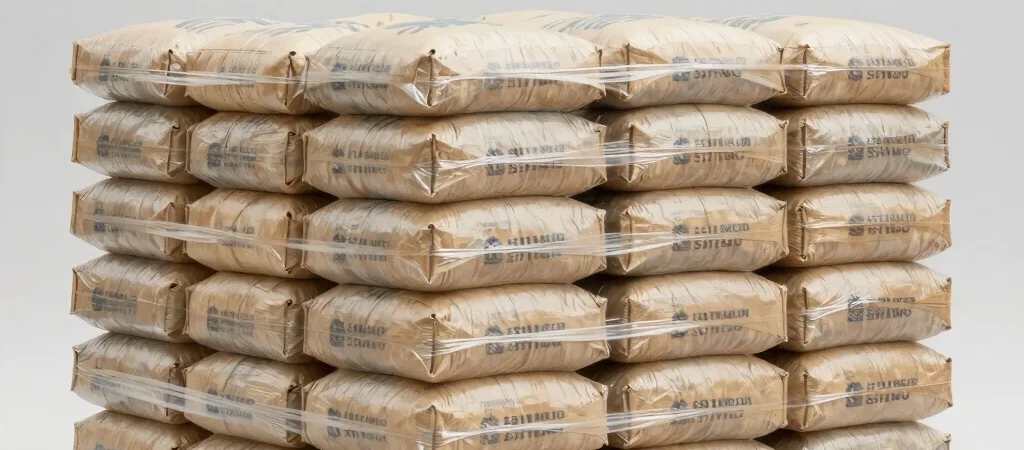
A pallet of pellets is usually about one tonne of fuel. In most of the world that means 65 to 67 bags of 15 kg, stacked and stretch-wrapped on a single wooden pallet. In North America it’s normally fifty 40 lb bags, which comes to one short ton, or roughly 907 kg. For a pellet stove used in the evenings, one pallet can last most of a winter. For a boiler heating a whole house, it might last a few weeks in the coldest months.
That’s the short answer. The longer one matters if you’re about to spend real money, because the number of bags, the weight, the grade and the storage space all change what you get for it. This guide goes through all of it in plain terms: what’s on a pallet of pellets, how much heat it holds, how to work out how many you need, what to check before buying, and how to store and receive one. We sell pellets by the pallet and by the truckload, so we’ve also pointed you to the right product at each step.
On this page
What is on a pallet of pellets?
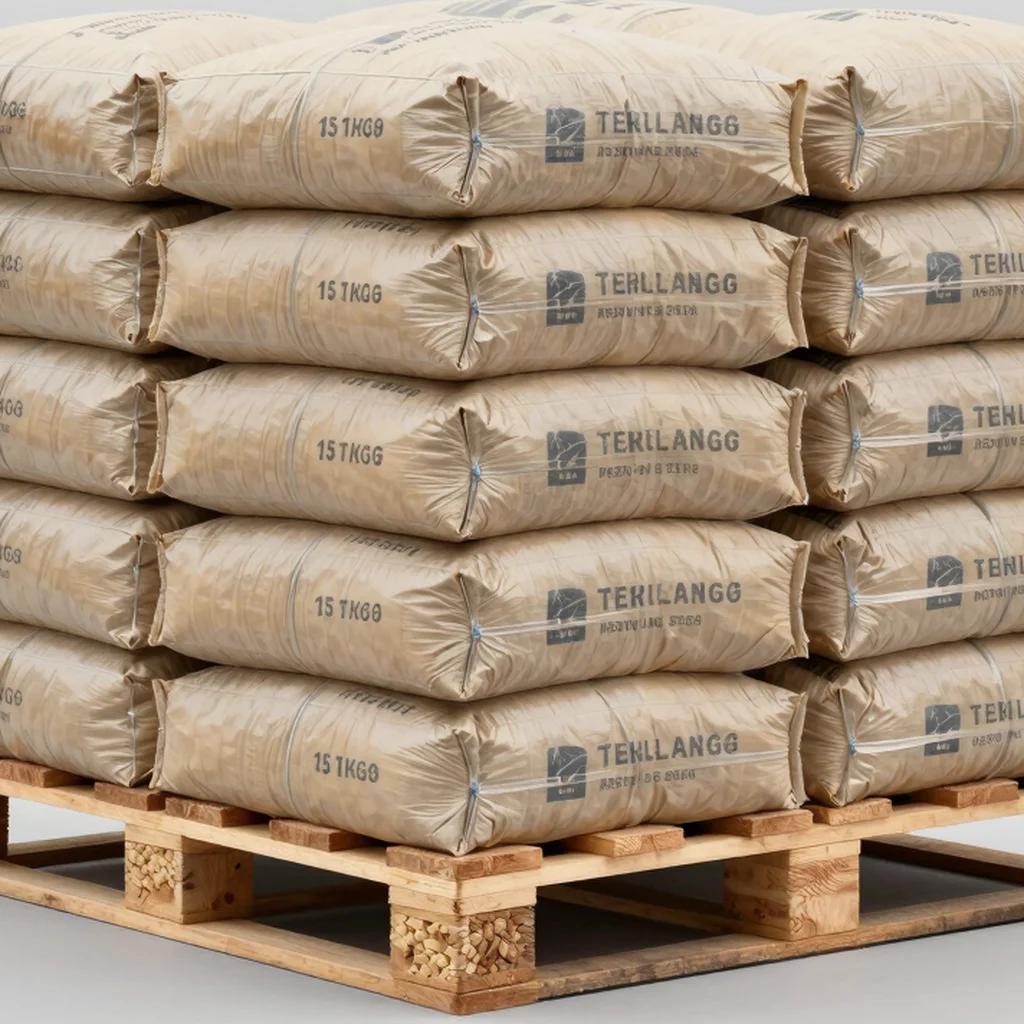
A pallet of pellets is a stack of bagged wood pellets sitting on a standard wooden pallet, wrapped in plastic film so the bags don’t shift or get wet in transit. Sellers price and ship pellets this way because it’s the unit a forklift, a pallet truck and a delivery lorry all handle easily.
The catch is that “a pallet” isn’t a fixed amount. It depends on the bag size and on whether the seller is talking about a metric tonne or a US ton. Here’s how the common formats compare:
| Bag size | Bags per pallet | Total weight | Where you’ll see it |
| 15 kg | 65 | 975 kg | Common across Europe and many export markets |
| 15 kg | 66 | 990 kg | Common across Europe and many export markets |
| 15 kg | 67 | 1,005 kg | Some full-tonne pallets |
| 40 lb (18.1 kg) | 50 | 2,000 lb (907 kg) | United States and Canada |
| 20 lb (9.1 kg) | 100 | 2,000 lb (907 kg) | Smaller bags for easier lifting |
The North American format is well documented. Mississippi State University’s extension service notes that most people buy pellets by the ton, as a pallet of fifty 40-pound bags. In Europe the 15 kg bag is the norm, and a full pallet of pellets usually lands between 975 kg and just over a tonne.
Why does this matter? Because a pallet of 50 × 40 lb bags holds about 93 kg less fuel than a pallet of 66 × 15 kg bags. If you’re comparing prices between sellers, or between countries, always convert to price per kilogram or per tonne. Comparing “per pallet” can mislead you by nearly 10%.
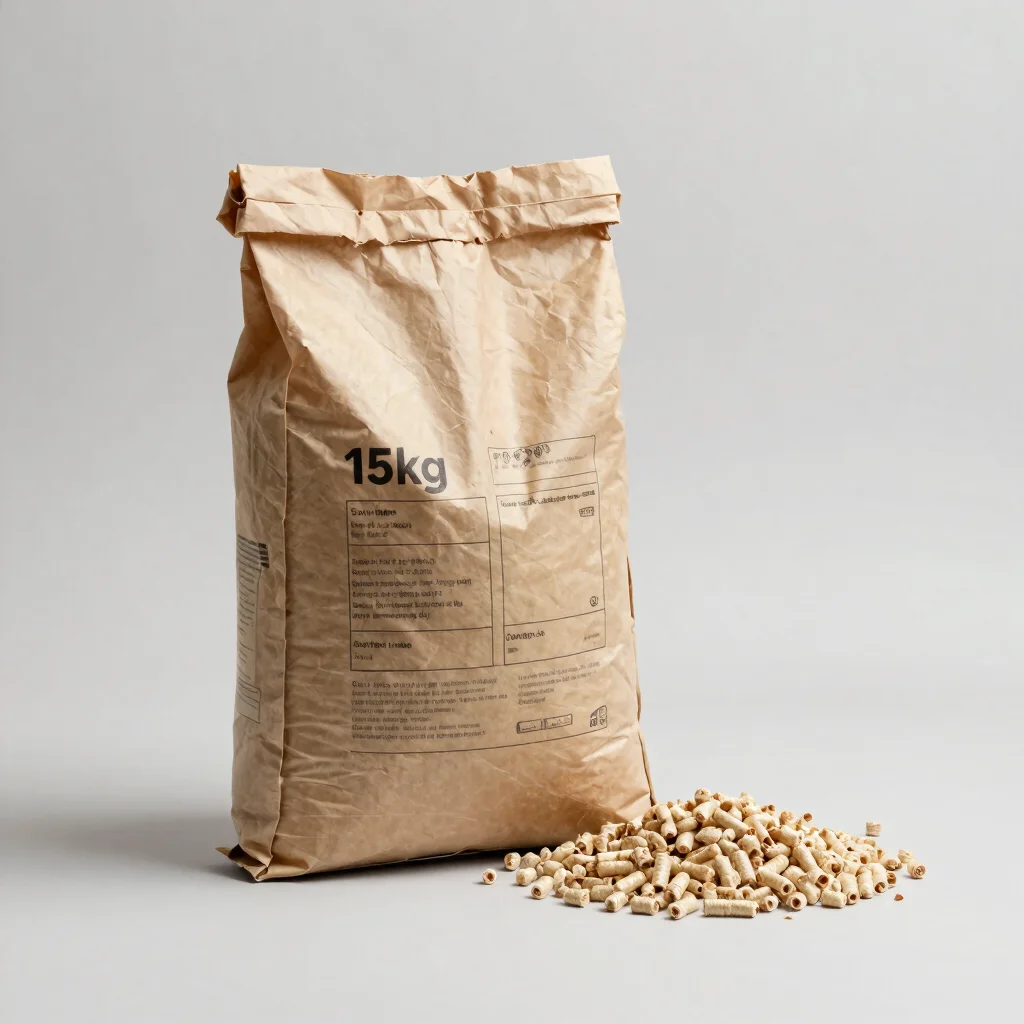
Our own pallets are built on 15 kg bags. The hardwood heating pellets and softwood heating pellets come as roughly one tonne per pallet, and the mixed pellet pallet is exactly 975 kg: 33 bags of softwood and 32 bags of hardwood.
Ton or tonne?
A metric tonne is 1,000 kg. A US “short” ton is 2,000 lb, which is about 907 kg. A UK “long” ton is about 1,016 kg, though you’ll rarely see it used for pellets now. When a seller says “one ton pallet”, ask which one they mean, or simply ask for the weight in kilograms.
How big and heavy is a pallet of pellets?
Expect a little over a tonne in total once you add the wooden pallet and the wrap. The pallet itself is usually a standard size. The European EUR pallet measures 1,200 × 800 mm and has a safe working load of 1,500 kg, so a tonne of bagged pellets sits comfortably within its limits. Some pellet producers use the slightly larger 1,200 × 1,000 mm industrial pallet instead. North American pellet pallets are normally 48 × 40 inches.
Height varies with bag shape and stacking pattern, but a full pallet of pellets usually stands somewhere between chest and head height. Before delivery day, measure any doorway, garage opening or gate the pallet has to pass through. A Euro pallet is 800 mm wide on its narrow side, which fits most standard doors when it’s carried in end first.
If you ever buy loose pellets instead of bags, volume matters too. ENplus-certified pellets must have a bulk density between 600 and 750 kg per cubic metre (more on ENplus below). That means a tonne of loose pellets takes up roughly 1.3 to 1.7 m³ of space. Bagged, it takes a little more, because of the gaps between bags.
How much heat is in a pallet of pellets?
This is the number that really tells you what you’re buying. The fuel’s energy content is called its net calorific value. Under the ENplus quality scheme, the most widely used pellet certification, both the A1 and A2 grades must deliver at least 16.5 MJ per kilogram, which is about 4.6 kWh/kg. Good pellets often test above that minimum.
So a one-tonne pallet of pellets that meets the standard holds at least 4,600 kWh of energy. In practice it will be somewhere around 4,600 to 5,000 kWh, depending on the batch.
To put that in familiar terms, compare it with heating oil. Austrian boiler maker ETA works on about 10 kWh per litre of oil and about 4.9 kWh per kilogram of pellets. On those figures, roughly two kilograms of pellets carry the same energy as one litre of oil. One pallet of pellets is the energy equivalent of about 460 to 490 litres of heating oil.
| Fuel | Typical energy content | Rough equivalent of one tonne of pellets |
| Wood pellets (ENplus minimum) | 4.6 kWh/kg | 4,600 kWh |
| Wood pellets (typical good batch) | about 4.8 to 5.0 kWh/kg | 4,800 to 5,000 kWh |
| Heating oil | about 10 kWh/litre | 460 to 500 litres |
Energy in the bag versus heat in the room
Not all of that energy ends up as heat in your home. Some goes up the flue. The US Environmental Protection Agency points out that overall efficiency, not combustion efficiency, tells you how much heat actually reaches the room, and that adverts often quote the higher combustion figure. When you do the sums below, use the overall efficiency from your appliance’s manual or test certificate. If you can’t find it, 80% is a fair working figure for a modern pellet stove and around 90% for a good pellet boiler, but treat those as estimates.
How long does a pallet of pellets last?
It depends on three things: how much heat your appliance puts out, how many hours a day it runs, and how efficient it is. Once you know those, the sum is simple.
Pellets burned per hour (kg) = heat output (kW) ÷ (4.8 × efficiency)
We use 4.8 kWh/kg as a middle-of-the-road figure for good pellets. Multiply the hourly figure by the hours you run the stove each day, and you have daily use. Divide 1,000 kg by daily use and you know roughly how many days one pallet of pellets will last.
Here are three worked examples. They’re estimates for illustration, not promises, because real use swings with the weather, the house and the person holding the thermostat.
| Situation | Average output | Hours a day | Pellets a day | One tonne lasts about |
| Room stove, evenings only | 4 kW | 5 | 5.2 kg (about a third of a bag) | 190 days |
| Room stove, most of the day | 5 kW | 12 | 15.6 kg (about one bag) | 64 days |
| Larger stove or insert, cold spell | 7 kW | 16 | 29 kg (about two bags) | 34 days |
All three assume 80% overall efficiency. You can see how much the answer moves. The same pallet of pellets can be a whole season for one household and a month for another.
The simplest real-world check is to count bags. If you already burn pellets, note how many bags you use in a normal cold week. A household using seven bags a week (one a day) will get through a 66-bag pallet in a little over nine weeks.
The quick rule of thumb
On the figures above, a room stove running most of a cold day uses roughly one 15 kg bag. If that matches your use, one pallet of pellets covers about two months of full-time heating, or a whole season if you only run the stove in the evenings. It’s a starting point, not a substitute for your own numbers.
How many pallets of pellets do you need for a winter?
For a whole-house pellet boiler, or a stove that’s your main heat source, work from your annual heat demand instead of guessing. There are three ways to get there.
1. From your old heating oil use
If you’re switching from oil, you already know how many litres you buy each year. Turn that into useful heat, then into pellets:
- Multiply your yearly litres by 10 to get kWh in the oil.
- Multiply by your old boiler’s efficiency (say 0.85) to get the heat you actually used.
- Divide by 4.8 × your new pellet appliance’s efficiency (say 0.9) to get kilograms of pellets.
| Oil used per year | Useful heat | Pellets needed (approx.) | Pallets |
| 1,000 litres | 8,500 kWh | 2.0 tonnes | 2 |
| 1,500 litres | 12,750 kWh | 3.0 tonnes | 3 |
| 2,000 litres | 17,000 kWh | 3.9 tonnes | 4 |
| 2,500 litres | 21,250 kWh | 4.9 tonnes | 5 |
2. From your gas or electricity bill
Gas bills usually show kWh already. Take the kWh you use for heating (leave out cooking and, if you can, summer hot water), multiply by your old boiler’s efficiency, and divide by 4.8 × the pellet appliance’s efficiency. For electric heating, the kWh on the bill is roughly the heat delivered, so you can skip the first efficiency step.
3. From the size of the appliance
If you have nothing else to go on, start from the appliance. The US Department of Energy gives a rule of thumb that a 60,000 Btu stove can heat a 2,000 sq ft home, and a 42,000 Btu stove about 1,300 sq ft. That’s roughly 17.6 kW and 12.3 kW. A stove sized for your space and run sensibly through the season will usually fall within the ranges in the table above.
Add a margin
Whichever method you use, add 10 to 15% for a hard winter. Running out in January is far more annoying than having a few bags left in April, and well-stored pellets keep until the next season. If your answer comes out at 2.6 tonnes, order three pallets of pellets, not two.
Hardwood or softwood: does it change how far a pallet goes?
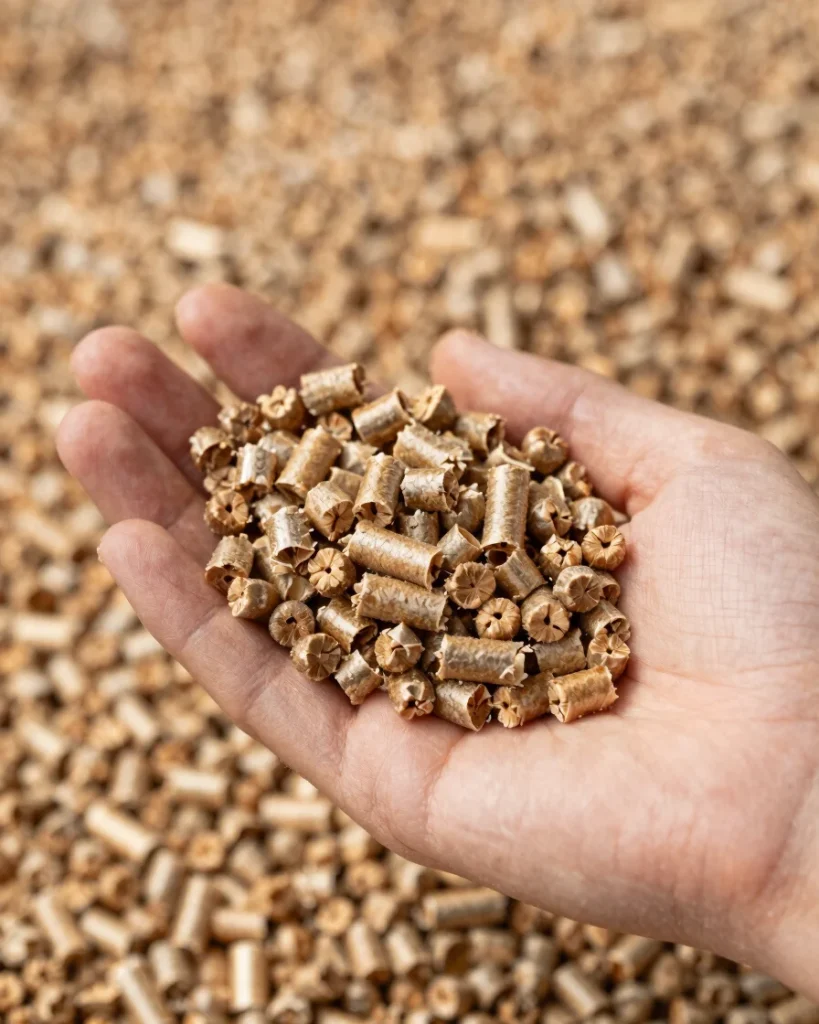
Less than people expect. The ENplus energy minimum is the same 4.6 kWh/kg whatever the wood, so a certified hardwood pallet of pellets and a certified softwood one both start from the same floor. Where they differ is in how they burn.
- Softwood (pine, spruce) lights quickly and burns hot and bright. It suits room stoves that switch on and off through the day. Our softwood heating pellets are 6 mm pine and spruce in 15 kg bags.
- Hardwood (oak, beech) is denser, takes a moment longer to catch, then burns slowly and evenly. It suits boilers on long cycles and colder climates. See our hardwood heating pellets and oak blend pellets.
Your appliance often has a preference. Some stoves are set up at the factory for softwood and need a little more combustion air to burn hardwood cleanly. If you’re not sure which suits you, the mixed pellet pallet lets you burn both side by side for a few weeks before you commit to a full season of one. The hardwood pellets guide and softwood pellets guide go into the differences in more depth.
What to check before you buy a pallet of pellets
Price per pallet is the first thing everyone looks at. These are the things that decide whether it’s actually good value.
1. The grade
Look for pellets certified to a recognised quality scheme. In Europe and in many export markets that’s ENplus, which sets limits for moisture, ash, durability and size. These are the main limits for the two household grades:
| Property | ENplus A1 | ENplus A2 |
| Diameter | 6 or 8 mm (±1 mm) | 6 or 8 mm (±1 mm) |
| Moisture | ≤ 10% | ≤ 10% |
| Ash | ≤ 0.7% | ≤ 1.2% |
| Mechanical durability | ≥ 98.0% | ≥ 97.5% |
| Bulk density | 600 to 750 kg/m³ | 600 to 750 kg/m³ |
| Net calorific value | ≥ 16.5 MJ/kg (4.6 kWh/kg) | ≥ 16.5 MJ/kg (4.6 kWh/kg) |
These figures come from the ENplus pellet quality requirements. Lower ash means less cleaning. Higher durability means fewer pellets crumble into dust in the bag. In North America, the EPA advises buyers to look for pellets certified by the Pellet Fuels Institute, which runs its own grading scheme.
If your stove or boiler warranty names a grade, follow it. Ask the seller which grade the current batch meets. We’re happy to confirm ours for the pallet of pellets you’re about to order.
2. Diameter
Most domestic stoves take 6 mm pellets. Some larger boilers are designed for 8 mm. Check your manual before ordering a full pallet of pellets. The wrong size can feed badly through the auger.
3. Weight per pallet
As covered above, count the bags and multiply by the bag weight. Ask “how many kilograms on the pallet?” and compare price per tonne.
4. Dust and fines
A little dust at the bottom of a bag is normal. A lot of it suggests rough handling, poor-quality pellets or damp storage. ENplus limits fines in bags at the point of sale, so a certified product should be clean.
5. What delivery includes
Ask whether the price includes delivery, whether the lorry has a tail lift and a pallet truck, and where the pallet will be left. Kerbside delivery is common. Moving a tonne up a gravel drive by hand is not fun. We confirm the delivery cost and the arrangements for your address before anything is dispatched.
6. Heating or cooking pellets
Heating pellets and BBQ pellets are different products. Don’t put heating pellets in a pellet grill. If you cook on one, buy a pallet of pellets sold for food, such as our hardwood BBQ pellets.
7. Bag quality
Look at the bags themselves. Thick, well-sealed plastic keeps moisture out in storage and survives being thrown about on a lorry. Thin bags that split at the corners leave you sweeping pellets off the garage floor. If the seller shows photos of the actual pallet, check that the wrap is tight and that the corners of the stack aren’t crushed.
8. One batch for the season
Pellets from different mills, or even different batches, can behave a little differently in the same stove. One may leave more ash. Another may need a slightly different feed rate. Buying your season’s fuel in one order, from one batch, means you set the stove up once and leave it. It’s one of the quieter advantages of buying a pallet of pellets, or several, at once.

How to store a pallet of pellets
Pellets are compressed sawdust. Keep them dry and they’ll last for a very long time. Mississippi State University’s extension service notes that pellets can be stored indefinitely, but they must be kept dry. Let them get wet and they swell, split and turn back into sawdust, which then jams augers and smothers burn pots.
A few practical rules:
- Keep it under a roof. A garage, dry shed, cellar or covered barn works. Rain on a pallet is the main thing to avoid.
- Keep it off the ground. Leave the pellets on their own pallet, or put boards underneath. Concrete floors can draw moisture up.
- Leave space around it. Keep the stack a little away from walls, especially outside walls that get cold and damp.
- Leave the wrap on. The factory wrap is your best weather protection. Cut it open from the top and take bags off as you need them.
- Open one bag at a time. Fold the top of a part-used bag over to keep moisture out.
- Keep fuel away from the stove. Store the pallet of pellets in a separate space, not next to the appliance. Bring in a bag or two at a time and follow the clearances in your stove manual.
If you store outdoors because you have no choice, use a proper cover that keeps the rain off the top but lets air move around the sides. Don’t seal the stack tightly in plastic sheeting, because condensation can build up underneath.
How much space do you need?
One standard pallet of pellets needs a floor space of roughly 1.2 × 0.8 m or 1.2 × 1.0 m, plus room to get a pallet truck in and out. Three or four pallets for a winter of whole-house heating will take up about the floor area of a small car if they can’t be stacked. Don’t stack full pallets unless the seller confirms it’s safe for that product.
What a pallet of pellets costs to run
Prices for pellets, oil, gas and electricity change all the time and differ from country to country, so we won’t quote figures that will be wrong by next month. What doesn’t change is the method. Once you know the price of a pallet of pellets, you can work out what each unit of heat costs and compare it fairly with any other fuel.
Cost per useful kWh = price per tonne ÷ (4,800 × efficiency)
Take a hypothetical price of 400 per tonne in your local currency, and a stove with 80% overall efficiency. 400 ÷ (4,800 × 0.8) = about 0.104 per kWh of heat delivered to the room, or 10.4 for every 100 kWh. Do the same for your other options:
- Heating oil: price per litre ÷ (10 × boiler efficiency)
- Mains gas: price per kWh on your bill ÷ boiler efficiency
- Electric heaters: price per kWh on your bill (they’re close to 100% efficient at the point of use)
- Heat pump: price per kWh ÷ the pump’s seasonal performance figure
Put the answers side by side and you have a real comparison, not a guess. Remember to add delivery to the pellet price, and to use the price per tonne, not per pallet, for the reasons covered earlier. A pallet of pellets with 975 kg on it and one with 1,005 kg on it are not the same buy, even at the same price.
The sum also shows why efficiency matters. The same pallet of pellets burned in a 70% appliance costs about 14% more per unit of heat than in an 80% one. If your stove is old, a service, or eventually a newer appliance, can be worth more than shopping around for cheaper fuel.
Getting a pallet of pellets delivered
A pallet of pellets weighs about a tonne, so delivery takes a little planning.
- Access. Can a lorry reach your property and park safely? Narrow lanes, low branches and soft verges are the usual problems.
- Ground. The pallet truck needs a firm, fairly level surface. Gravel, grass and steep slopes make moving a tonne very hard.
- Drop point. Decide in advance where the pallet should go. If it can’t reach your shed, you can break it down and carry the bags. Sixty-odd trips with a 15 kg bag is a workout, but it’s doable.
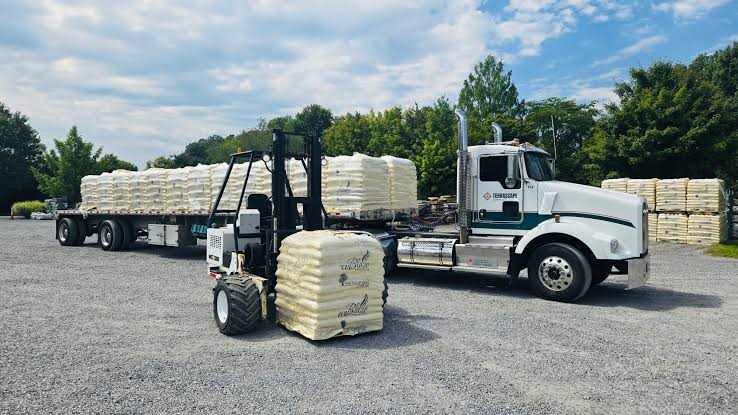
- Someone at home. Be there to check the delivery. Count the pallets, look for torn wrap or wet bags, and note any damage on the delivery paperwork before the driver leaves.
When you order from us, we confirm the freight cost for your address and talk through access before dispatch. We deliver worldwide. Freight depends on distance and on how many pallets of pellets you order, so we agree it with you up front. If anything about your site is awkward, mention it in the order notes or get in touch first.
Checking a pallet of pellets when it arrives
Five minutes with the driver still there can save a lot of back-and-forth later. Here’s what to look at.
- Count. Check the number of pallets against your order, and if you can, the number of bags on each.
- Wrap. The film should be intact. Torn wrap isn’t a disaster on its own, but look closely at the bags underneath.
- Damp. Look for wet patches, especially at the bottom of the stack where the pallet sat on the lorry floor.
- Crushed bags. A few scuffed corners are normal. Split bags spilling pellets are worth noting.
- Paperwork. Write any damage on the delivery note and take a photo before the driver leaves.
Later, open one bag and have a look. Good pellets are firm, smooth and slightly shiny, and they snap cleanly rather than crumbling. There should be only a little dust at the bottom of the bag. If you’re unsure, drop a handful into a glass of water. Good pellets sink and swell slowly over a few minutes. Pellets that fall apart almost at once have probably taken on moisture somewhere along the way.
If something isn’t right with a pallet of pellets we’ve delivered, tell us the same day through the contact page with a photo. Problems recorded at delivery are much easier to sort out than ones found weeks later.
Getting the most from every pallet of pellets
How you run the appliance makes a real difference to how long a pallet of pellets lasts. None of this is complicated.
- Clean the burn pot regularly. Ash build-up starves the fire of air, which wastes fuel and makes the flame lazy and sooty. Most manuals give a daily or weekly routine.
- Keep the glass and heat exchanger clean. Soot on the exchanger acts like insulation and sends heat up the flue instead of into the room.
- Get an annual service. Seals, fans and sensors wear. A stove that’s out of adjustment can burn noticeably more fuel for the same warmth.
- Don’t oversize the setting. The US Department of Energy notes that an appliance that’s too big for the space tends to be run at a low smoulder, which wastes fuel and adds to air pollution. Run at a steady, sensible output instead.
- Pour from the top of the bag. Leave the last handful of dust in the bag rather than tipping it into the hopper.
- Use the oldest bags first. Rotate stock so nothing sits in storage for longer than it needs to.
- Look after the house. Draught-proofing and insulation reduce the heat you need in the first place. Every kWh you don’t lose is fuel you don’t buy.
The EPA’s pellet stove guidance makes a related point: lower-quality pellets can give less heat and create fine dust, while better pellets tend to burn cleaner with less ash. Good fuel and a well-kept appliance work together.
One pallet, several pallets, or a full truckload?
Once you know your annual use, the buying decision is fairly simple.
| Your situation | What usually makes sense | Product |
| Room stove, evenings and weekends | One pallet of pellets a season | Softwood heating pellets |
| Stove as main heat, or a small boiler | Two to four pallets, ordered before the cold | Hardwood heating pellets |
| Not sure which wood suits your appliance | One mixed pallet to test both | Mixed pellet pallet |
| Prefer oak-based fuel | One or more pallets | Oak blend pellets |
| Reseller, farm, estate or large boiler | A 24-tonne truckload | Bulk softwood pellets or bulk hardwood pellets |
| Pellet grill or smoker | A pallet of cooking pellets | Hardwood BBQ pellets or softwood BBQ pellets |
A truckload makes sense when you’ll burn or sell around 24 tonnes in a season and have covered space for about two dozen pallets. Below that, ordering single pallets is easier to store and to pay for. Both truckload options are in the wood pellet truckload category.
When to buy
Demand for pellets rises as the weather turns cold, and delivery slots fill up. Buying before the heating season starts means you choose the delivery date, rather than taking whatever is left in December. If you have the storage space, it’s the calmer way to do it.
A pallet of pellets for cooking
Not every pallet of pellets goes into a stove. Caterers, food trucks, barbecue teams and keen home cooks buy grill pellets by the pallet, because it keeps the fuel consistent from one cook to the next and saves buying small bags over and over.
For low-and-slow smoking, hardwood is the usual choice. Its smoke is clean and mild. Our hardwood BBQ pellets come by the tonne for exactly this. For fast, high-heat grilling, the softwood BBQ pellets light quickly and run hot. Store a cooking pallet of pellets the same way as heating fuel: dry, covered and off the floor.
A worked example from start to finish
Here’s how the sums work for a hypothetical buyer. Say you heat a three-bedroom house, you’re replacing an old oil boiler with a pellet boiler, and you used about 1,500 litres of oil a year. The working goes like this:
- 1,500 litres × 10 kWh = 15,000 kWh in the oil.
- × 0.85 old boiler efficiency = 12,750 kWh of heat actually used.
- ÷ (4.8 × 0.9 for the new pellet boiler) = about 2,950 kg of pellets.
- Plus a 10% margin = about 3,250 kg.
In that case you’d order three or four pallets of hardwood heating pellets before autumn, then keep a note of how many bags you use each week. By February you’ll know whether three was enough, and next year you can order with confidence. Three pallets fit side by side in a single garage bay, left on their original pallets with a gap from the wall.
Run the same sums for a small room stove used only in the evenings and the answer is usually one pallet of pellets for the whole winter, with bags left over.
Common mistakes when buying a pallet of pellets
- Comparing pallets, not kilograms. A cheaper pallet of pellets with fewer or lighter bags isn’t always cheaper fuel.
- Ignoring the grade. Uncertified pellets can be fine, but you can’t check. High ash and dust cost you in cleaning and breakdowns.
- Storing outside under a tarp. Condensation and rain splash will find the bottom bags.
- Ordering too late. Mid-winter is when delivery slots are tightest.
- Not planning the drop point. A tonne left on the wrong side of a gravel drive will need carrying by hand.
- Buying heating pellets for a grill. Different product, different purpose.
Frequently asked questions
How many bags are in a pallet of pellets?
Usually 65 to 67 bags of 15 kg in Europe and many other markets, or 50 bags of 40 lb in North America. Always check the seller’s listing for the exact count.
How much does a pallet of pellets weigh?
About one tonne of fuel, plus roughly 20 to 25 kg for the wooden pallet. A North American “ton” pallet holds 2,000 lb, about 907 kg, of pellets.
How long does a pallet of pellets last?
Anywhere from about a month to a whole season. A room stove used for a few hours each evening might take most of a winter to get through one pallet. A stove heating a house all day in cold weather can use a bag or two a day, so a pallet lasts one to two months.
How many pallets of pellets do I need for a winter?
Work from your annual heat demand. As a rough guide, a home that used 1,500 litres of oil a year needs about three tonnes of pellets with a modern pellet boiler. Add 10 to 15% for a cold year.
Can I store a pallet of pellets outside?
Only if it’s properly covered and off the ground, and even then a garage or shed is better. Pellets that get wet swell and break down.
Do pellets go off?
Not if they stay dry. Store them under cover, off the floor and in their sealed bags, and they’ll keep from one season to the next.
Is hardwood or softwood better value per pallet?
Certified pellets of either type have to meet the same minimum energy content, so value comes down to price per tonne and how well the fuel suits your appliance. Try the mixed pellet pallet if you’re not sure.
What’s the difference between a pallet of pellets and a big bag?
A big bag (sometimes called a bulk bag or tote) holds loose pellets, often around a tonne, in one large woven sack. It suits buyers with a pellet store or silo who can empty it straight in. A pallet of pellets holds the same fuel in small bags you can carry one at a time, which is far easier if your stove has a hopper you fill by hand.
Can I split a pallet of pellets with a neighbour?
Yes, and plenty of people do. You pay for one delivery, take the pallet, and hand over the agreed number of bags. Just agree beforehand who stores it and how the delivery cost is shared.
Can you deliver a pallet of pellets to me?
We deliver worldwide. Add the pallet to your basket, and we confirm the delivery cost and the arrangements for your address before dispatch. Browse the full range in the shop, or start with the hardwood pellets and softwood pellets categories.
Ready to order?
If you’ve done the sums and know how many tonnes you need, the next step is choosing the fuel. For most home heating, start with a pallet of hardwood heating pellets or softwood heating pellets. If you burn wood logs as well, our dried firewood is sold by the full cord. Questions about grades, bag counts or delivery can go through the contact page, and you can read more about how we store and ship stock on the about page.
Sources and References
- ENplus handbook, part 3: pellet quality requirements (European Pellet Council)
- ENplus certification scheme for wood pellets
- Wood Pellets: An Introduction (Mississippi State University Extension)
- Burn Wise: energy efficiency and pellet certification (US EPA)
- Burn Wise: pellet stoves (US EPA)
- Wood and pellet heating (US Department of Energy)
- Heating costs in comparison: energy content of oil and pellets (ETA Heiztechnik)
- EUR-pallet dimensions and load ratings